

Would You Know If a Scammer Was Using Your Daughter’s Voice?
October is Cybersecurity Awareness Month. But unlike previous years, when updating your software, strengthening your passwords, and watching for phishing emails were enough, this year’s conversation is focused on the fact that a stranger with a laptop can now borrow someone’s voice.1
We want to pass along a story like the one below to make you aware of what can happen and how quickly it can take place.
Last spring, a mother in California picked up her phone and heard her daughter’s voice, panicked, saying she had been kidnapped and needed money sent right away.2
The pitch was right. The tone was right. She wired $5,400 before learning her daughter was safe the entire time. What she’d heard on the phone wasn’t her daughter. It was an artificial recreation of her voice, built from a few seconds of audio pulled from somewhere online.
Deloitte’s Center for Financial Services projects that generative AI-enabled fraud could cost Americans as much as $40 billion a year by 2027, up from $12.3 billion in 2023.3
Voice cloning is one of the fastest-moving pieces of that trend. The FBI has also warned about so-called virtual kidnapping schemes, where scammers pair a threatening message with an altered photo or video pulled from images a family already posted online, timed so there’s little room to notice the small details that would otherwise give the fake away.4
Three Seconds Is All It Takes
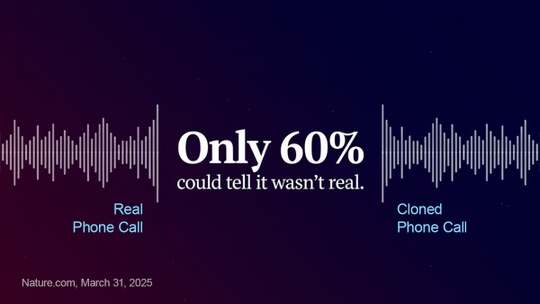
Researchers at McAfee found that just three seconds of audio, roughly the length of the average voicemail greeting, was enough to produce a voice clone with an 85 percent match to the original speaker. Roughly one in four people surveyed said they had personally experienced an AI voice scam or knew someone who had, and seven in ten said they weren’t confident they could tell a cloned voice from the real one.5
The Numbers Behind the Headlines
The FBI linked more than 22,000 complaints and roughly $893 million in losses to AI-enabled schemes in 2025. Adults 60 and older accounted for $352 million of that figure, and the broader elder fraud numbers are starker still, with reported losses climbing to $7.7 billion in 2025.6,7
A Simple Safeguard Worth Having in Place
Cyber professionals recommend one simple fix: agree on a private family code word or verification question, in person, never shared digitally, that a scammer’s cloned voice could not possibly know. If a call ever sounds even slightly off, hanging up and calling the person back on a number you already have saved ends the scam almost immediately.8
If your family hasn’t talked through what you’d do if a call like this came in, it may be worth ten minutes at your next gathering.
We will continue to send you updates on best practices in cybersecurity because raising awareness is critical to helping protect your family. Protecting what you’ve built is more than money and markets. It’s about staying ahead of the people who want to take it from you.
1. CISA.gov, 2026.
2. Moneywise.com, 2026.
3. Deloitte.com, 2026.
4. FBI.gov, December 2025.
5. McAfee.com, 2026.
6. FBI.gov, 2026.
7. IC3.gov, 2025.
8. FTC.gov, 2026.
